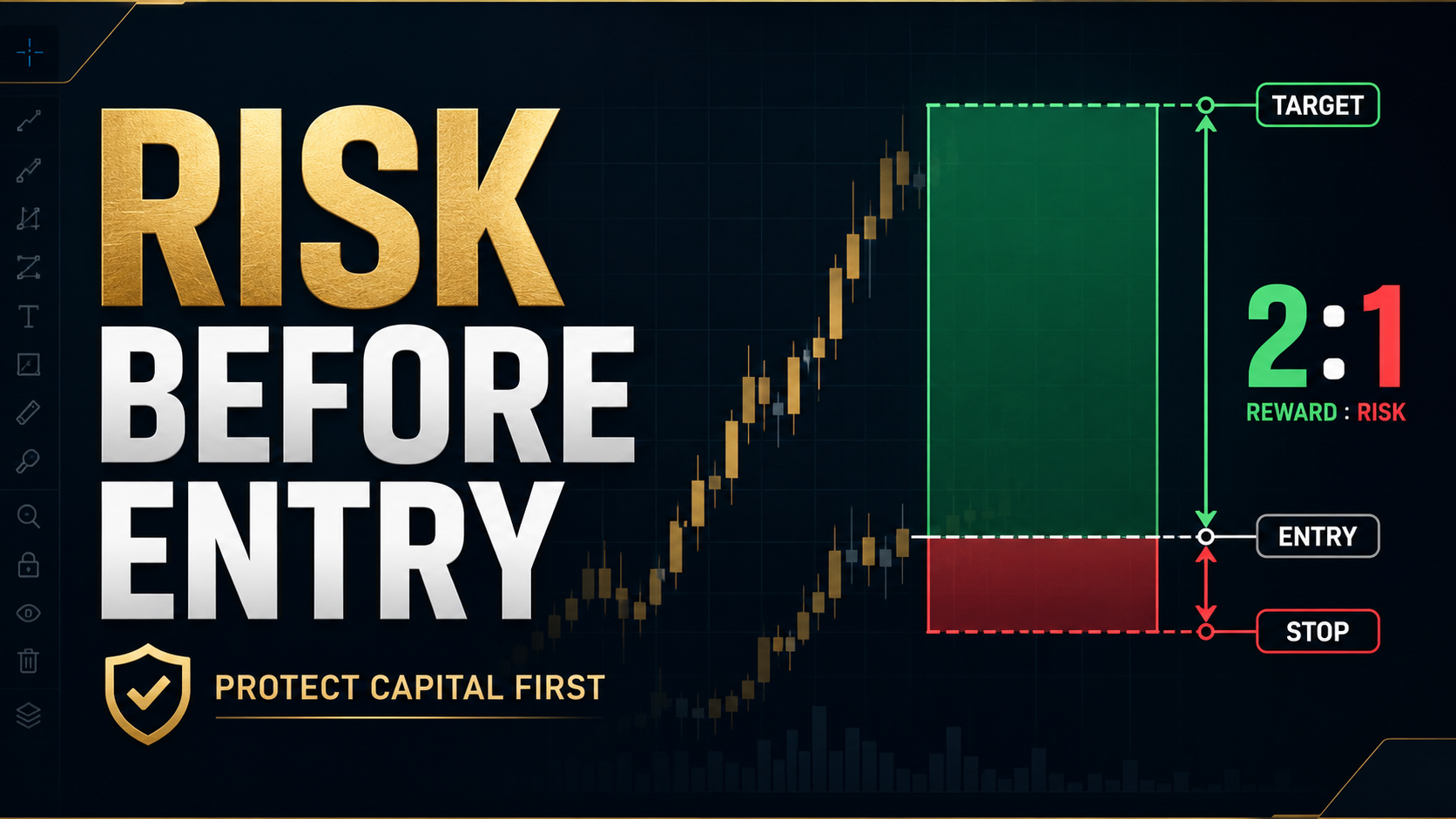
New traders often obsess about finding the perfect entry point. They study charts endlessly, develop complex trading systems, and look for the “holy grail” entry signal. But this is backwards. The best traders obsess about risk management first and entries second.
The Brutal Truth
You will be wrong. Often. Even professionals with decades of experience lose money on individual trades. The difference between professional traders and losing traders isn’t that professionals are right more often—it’s that professionals manage their losses better.
A trader who is right 40% of the time but cuts losses quickly can still be profitable. A trader who is right 60% of the time but lets losses run can still lose money.
Position Sizing: The Foundation
Before you enter any trade, know exactly how much you’re willing to lose. This is position sizing—deciding how many shares, contracts, or dollars to risk on the trade.
The Rule: Never risk more than 1-2% of your account on a single trade.
If you have a $10,000 account, you should never risk more than $100-200 on a single trade. This means if your stop loss is 50 points away, you can only buy a position that loses $100-200 if those 50 points are hit.
This might sound small, but it’s the foundation of survival. Protect your account and you can trade forever. Ignore position sizing and you can blow up your account in weeks.
The Stop Loss: Your Insurance
Before you enter a trade, you must know where you’ll exit if the trade goes against you. This is your stop loss.
Your stop loss should be:
- At a logical price level (support/resistance, key structure)
- Close enough to be realistic (not so tight you get stopped out by noise)
- Far enough to give the trade room to work
- A fixed location, not a trailing percentage
The traders who say “I’ll take my stop loss when the trade tells me to” are the ones who don’t take stops at all and blow up their accounts.
The Reward-to-Risk Ratio
Once you know your risk (position size × distance to stop loss), ask yourself: Is this trade worth taking?
Calculate your reward-to-risk:
If you risk $100 to make $200, that’s a 2:1 reward-to-risk ratio. That’s worth taking.
If you risk $100 to make $50, that’s a 0.5:1 ratio. That’s not worth taking.
Many traders skip this step and take trades where they risk $100 to make $50. Over time, even if they’re right 60% of the time, they lose money because their losses are bigger than their wins.
Risk of Ruin: The Math
This is where discipline separates pros from amateurs:
If you risk 5% of your account per trade and lose 5 times in a row (which will happen), you’ve lost 25% of your account. If you lose 10 times in a row, you’ve lost your entire account.
If you risk 1% of your account per trade, you can lose 70 times in a row and still have most of your account. This gives you the freedom to be wrong and still survive.
The math is simple: the smaller your risk per trade, the longer you can stay in the game.
Trading Plan vs. Flying by Instinct
Before you enter any trade, write down:
- Where you’ll enter
- Where your stop loss is
- Where you’ll take profits
- Why you’re taking this trade (what price action triggered it?)
- How much you’re risking
Then execute the plan. Don’t deviate. Don’t let emotion override your plan.
Traders who skip this step and trade by instinct lose. It’s not because they can’t read charts—it’s because emotions cloud judgment when real money is on the line.
The Losing Streak Will Come
Every trader experiences losing streaks. Professional traders expect them. They know their position size and risk per trade is small enough to survive 10, 20, even 30 losses in a row.
New traders are shocked by losing streaks and often panic, which leads to either revenge trading or giving up.
If you’ve sized your positions correctly, a losing streak is just part of the job. It doesn’t hurt your account badly. You can learn from it and move on.
Your Real Edge
Here’s something most traders never realize: Your edge isn’t a magical entry signal. Your edge is discipline in risk management. That’s it.
If you can:
- Size positions correctly
- Take losses when the trade goes against you
- Avoid revenge trading after losses
- Trade the same system consistently
…you’ll outperform 90% of traders regardless of what system you use.
Practice Exercise
Before your next trade:
- Calculate what you’re willing to lose (1-2% of account)
- Identify your stop loss price
- Calculate the distance to your stop loss
- Determine how many shares/contracts you can buy while respecting your risk
- Identify your profit target and calculate reward-to-risk
- Only take the trade if reward-to-risk is at least 1.5:1
Do this for 10 trades and watch your results. The discipline will change everything.
Final Thoughts
The reason successful traders make money isn’t because they’re always right. It’s because they manage risk so carefully that their wins exceed their losses even when they’re wrong more often than right.
Risk management is boring. It doesn’t generate exciting stories. But it’s the difference between a trader who survives for decades and one who blows up their account in a year.
Master risk management first. Everything else follows.
SkyVestments content is provided for educational and informational purposes only and is not financial or investment advice. Markets involve risk, and individuals should make their own informed financial decisions.
Educational Disclaimer: SkyVestments content is provided for educational and informational purposes only and is not financial or investment advice. Markets involve risk, and individuals should make their own informed financial decisions.